Dan Price's underground home, art, and philosophy on $5,000/year and 35 years underground: Dan Price's living free on tranquil river meadow
Dan Price has spent most of his adult life in a tiny underground dwelling in the woods of northeastern Oregon. In 2015, Kirsten Dirksen of faircompanies, a media project focused on sustainable living and alternative housing, made a documentary about his home and unconventional lifestyle, titled Dan Price's underground home, art & philosophy on $5,000/year. Ten years later, Dirksen returned to see how Price's experiment in simple living had evolved and filmed 35 Years Underground: Dan Price's living free on tranquil river meadow.
Together, her two films offer an intimate look at Price's unconventional lifestyle and how it took shape. We learn that in 1990 he arranged to rent a two-acre meadow in Joseph, Oregon, for $100 a year, in exchange for maintaining the property. He experimented with several forms of shelter before settling underground. His first shelters included a teepee, a small dome hut made of red willow and a four-season mountain tent. He eventually built a 6-by-10-foot beach-shack-style cabin. After someone broke in through a skylight and stole his photography equipment and computer, Price tore down the cabin, leaving only the sleeping room he'd excavated into the hillside behind it. He made this 80-square-foot room his new home and has lived there ever since on about $5,000 a year.
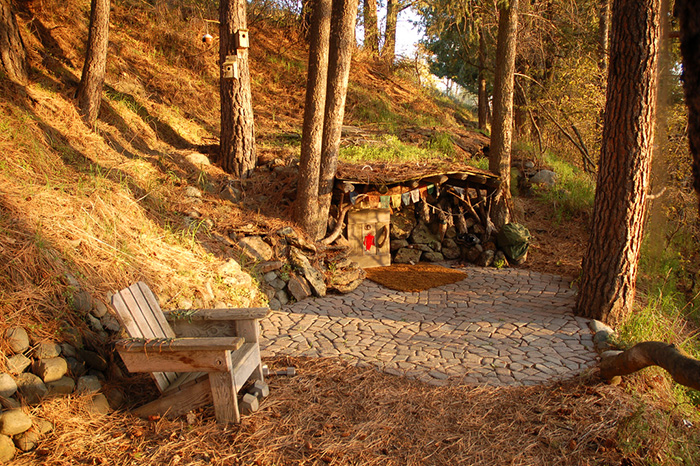
The first film opens with a beautiful wide shot of Price's home nestled into a wooded hillside. The home is so thoroughly integrated into the hillside–its walls made of piled rocks, its roof a continuation of the slope above–that it almost disappears into the landscape. Only a few feet of the entrance are above ground, and the front door is just three feet tall.
"Why so small?" asks Dirksen. "I don't know," answers Price as he squats to crawl inside. "I just like building little things, right? Just like a little fort, yeah. I built little forts always when I was a kid. I just kept kind of building forts and making them nicer and nicer so that I could actually live in them."
A low-angle shot of the interior reveals how spacious the tiny dwelling is. We see that it has carpeting, wood-paneled walls and ceiling, shelves, a workspace, a sleeping area and a skylight. Price says it stays around 50 degrees Fahrenheit, even in winter, thanks to the insulation of the surrounding earth. The walls and ceiling are made of boards turned on edge and nailed together for stability, then waterproofed. In a nod to the circular floor plan of the teepees Price lived in for so long, the structure is not rectangular but round.
In his kitchen, Price shows us a hotplate he says he sometimes uses to cook rice, eggs and canned soup. Otherwise, he eats raw vegetables, fruit, homemade cereal, nuts, crackers and cheese. "[K]ind of like how you would eat if you were backpacking," he adds. His cutting board doubles as a dining table and hangs from a hook when not in use.
Dirksen agrees that the space doesn't feel cramped, even though she and Price can't stand and must crawl through a circular opening to reach the bedroom. The latter has warm yellow walls, a shelf of favorite books and a two-inch sleeping pad. A deer trail runs along the hillside above the home, and Price says he sometimes hears deer walking on the roof at night.
Back outside, Price points out the utility pole and composting toilet. He gets electricity from a power line installed with approval from the county and city. The outhouse is also a tool shed and a gallery for his drawings.
Price next shows Dirksen his art studio, another underground, hobbit-like structure. Built from discarded wood and stone, it cost less than $100 to make. He talks about his former work as a newspaper photographer, magazine publisher and painter, then thumbs through an issue of Moonlight Chronicles, a magazine he created. The magazine ran for 77 issues and documented his travels around the world. Its whimsical illustrations document his travels, camping adventures, and observations of the natural world and rural life. He also shows Dirksen his 2005 book Radical Simplicity, about living lightly and finding freedom through simple living.
Asked whether he still works, Price says he no longer needs to. "If you can learn to live really tiny," he says, "it's not expensive."
The film gives us fascinating glimpses into Price's philosophy. We learn that he identifies with the hermits throughout history who have retreated to tiny mountain shelters in search of "peace from the madness of the world." Backpacking and camping have also helped shape his philosophy: "I liked that so much that I thought, Wouldn't it be neat if you could just live that way?" His background in photo editing is another influence: "I think I've edited my life all along." And then there are the hobbits of J. R. R. Tolkien's novels, who inspired Price to add a small, hobbit-like porch to the home.
They tour the meadow, which Price calls his "personal church." He points out saplings protected by wire-mesh guards and a spring he discovered and now uses as his water source. In his garden, he shows Dirksen patches of lettuce, garlic, spearmint and lamb's-quarters, a wild green he says is more nutritious than commercially grown spinach.
They then walk to an idyllic riverbank, where Price has a fire pit, dock, propane-heated underground sauna and a ring of lawn chairs. The dock, sauna and chairs are made from recycled wood, and Price embraces their impermanence. Rather than using treated wood designed to last, he enjoys rebuilding his dock every couple of years because it allows him to experiment with different locations and designs. An Adirondack chair is made of driftwood pieces that fit together like a puzzle, without the need for nails.
Other highlights include a small woodshed, a homemade barbell fashioned from a metal bar and two concrete-filled coffee cans, and a gravity-fed outdoor shower. The shower's water passes through a series of stacked buckets, including one fitted with a store-bought filter, before being heated with propane.
In one scene, Price discusses his efforts to remain involved in his children's lives after his divorce. He shows Dirksen a lampshade decoupaged with family photos. He says he offered to build a hut for his children to stay in when they visited, but they declined, fearing their friends would find it strange. This prompts Price to say that he has few friends of his own and prefers it that way, since most people he might befriend would pressure him to adopt the conventional, consumption-oriented lifestyle he has rejected.
The films leave some questions unanswered. Price mentions a car, but we never see it. We might imagine he uses it to drive into town to dispose of packaging and other waste from the few consumer goods he buys, but the films don't address this. Nor does Price mention whether he owns a phone or computer. But I'm fine with these omissions because I don't need the film to document every practical detail of Price's life.
The first film ends on a wistful note as Price describes how this whole project was born of a desire to recapture the carefree existence of childhood. His words play over a montage of him playing a handpan (a steel percussion instrument that makes shimmering, bell-like sounds) and cutting hay with a traditional scythe. He adds that he has yet to explore the entire property and looks forward to doing so.
By the time of the 2025 film, Price is 68 and has spent 35 years living underground. The saplings shown in the first film have grown into mature trees. Price's electricity bill averages about $40 a month, and he still pays the same rent in exchange for caring for the meadow.
Dirksen marvels at how well the arrangement has held up. "Not much has changed," she says. "It was set up well, I guess, if you haven't changed." Price agrees, saying he remains content with his simple life and the lack of neighbors: "I'm just looking at trees."
A smartphone appears in a couple of scenes, answering the question left open by the previous film as to whether he uses one. This prompts a brief exchange about his selective use of technology. "I love that you've embraced the stuff that works for you," Dirksen says. "Yeah, no reason to be a Luddite," Price agrees. He doesn't have a television or an internet connection, and it's clear he doesn't miss either.
The second film reveals several other developments: Price gets his reading material from the library, has added an outdoor, earth-cooled refrigerator to the home and has embraced eating "weeds." (He considers weeds healthier than conventionally grown produce because they haven't been treated with pesticides or herbicides.)
And, by way of archival footage and photographs, hand-drawn building plans and letters to his landlord, we're filled in on more of the backstory to Price's life on the meadow. The letters, which document the work he's done to the property under his rental agreement, are a delight. He calls them "passionate yearly letters," and they have an almost childlike scrawl that recalls the lettering in Moonlight Chronicles.
Another surprise since the first film is that Price spends several months each year traveling and surfing. After working in a surf shop to learn about surfing, he began making annual winter trips to Hawaii. His living arrangements during these trips are ingenious: He buys an inexpensive used minivan as soon as he arrives, removes its seats and converts the back into a tiny living space. At the end of his stay, he reinstalls the seats and resells the vehicle. He began doing this after 50 and has made it an annual tradition. He marvels that a logger's son could become part of the Hawaiian surfing community in middle age.
The second film also reveals how Price avoids the huge medical bills that tend to crop up when you don't have employer-provided health insurance. In recent years, he has had multiple heart attacks and has even been airlifted, but his medical expenses have been negligible thanks to his membership in Life Flight, a nonprofit emergency medical transport service.
My favorite part of the second film is Price's test for streamlining his lifestyle: "Take every aspect of how a person lives and say, 'Well, do I want to do it that way?'" How much happier and more financially secure might many others be if they asked themselves the same question?
