Environmental Destruction in 80,000 Photos
The Deutsche Welle documentary The Documerica Project: Environmental destruction in 80,000 photos tells the story of an ambitious 1970s federal initiative called Documerica, which sought to "establish a visual inventory of the environment in the United States." The project enlisted 100 photographers who took more than 80,000 images of pollution and other industrial impacts. The documentary interviews several of the photographers, along with historians and other experts, and makes brilliant use of many of the photographs to help tell the story.
The film has a nostalgic tone as it opens with a series of present-day interviews with Documerica photographers. It shows them revisiting and reminiscing about their old photos at light tables and follows them out into the field as they continue their work of visually capturing the detritus of industrial society. The photographers talk movingly about their artistic visions, their memories of certain photographs, and the environmental crises that motivated them to join the effort.
Boyd Norton recalls how angered he was when the Cuyahoga River in Ohio famously caught fire because it was so polluted with petroleum, and the film shows photos of the river with a vast wall of black smoke billowing across its surface as far and high as the eye can see. Norton says this disaster turned him into a "tree-hugging environmentalist" determined to use his photography to raise awareness about environmental destruction. He was struck by our society's startling dichotomy: how environmental neglect existed alongside extraordinary human achievements. "[W]e had the technology at that point to put a man on the moon," he says, "and yet we couldn't keep our damn rivers clean."
We learn about the structure and workings of the Documerica Project, as well as how the photographers approached their work. The project was established by Environmental Protection Agency director William Ruckelshaus and overseen by Gifford Hampshire. Hampshire assigned subjects but gave the photographers complete freedom to explore and interpret them, though he emphasized the importance of a human-centered perspective. John H. White and Terry Eiler recall reveling in this freedom and the way it allowed them to engage with communities directly and flex their creativity. "We never had any creative handcuffs," says White. "It allowed us to spread our wings, and that was the exciting thing because I could do it all."
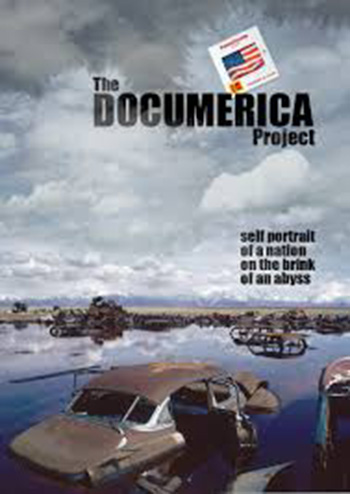
We see many of the photographs. Some appear in rapid-fire montages, while others are discussed at length. The latter include a shot of a landfill where tires fill the foreground and the Twin Towers loom in the background, in a brilliant juxtaposition of human achievement and environmental ruin. There's another great shot of a landfill, one in which a fast food beverage cup bearing a cheery slogan sits in the foreground with towering heaps of trash behind it. This image elegantly conveys the progression from drive-through frivolity to mountainous waste. And, in keeping with Documerica's people-first approach, we see photos showing how people have adapted to their degraded environments: children climbing across submerged cars, a man lounging amid wrecked vehicles, kids running up slides in an abandoned water park.
Historians David Stradling, of the University of Cincinnati, and Bruce Schulman, of Boston University, provide context for the environmental crises of the late 1960s and early 1970s. They explain how events such as the Cuyahoga fire and the Santa Barbara oil spill, along with growing street protests, spurred public concern and political action. They recount how President Richard Nixon promoted new pollution-control laws and supported the creation of the EPA. It's noted that while these actions were motivated more by political gain than by genuine concern, they still resulted in important environmental reforms that, sadly, are now languishing. These historians' insights situate Documerica within a broader social, political, and environmental landscape.
For all its ambition, Documerica failed to grab the public's attention and was quietly terminated. "[U]nfortunately, no one was really paying attention," recalls one photographer, "and then, just within a few years, it sort of gradually faded away." Some quarters of the EPA criticized Documerica for going beyond its mandate, and Washington bureaucracies at the time were conservative and had little motivation to showcase the images it had produced. And events like the Yom Kippur War, the oil embargo and the ensuing energy crisis had diverted public attention from environmental concerns for the time being. The media landscape was also changing, with magazines losing ground to television, meaning fewer people were seeing the published photographs. Photographers describe feeling "sad and angry" as the project ended and their work became inaccessible, scattered across different archives. Some tried lobbying Congress, to no avail.
The documentary grapples with a fundamental challenge of environmental photography: the fact that pollution can be visually seductive. Oil spills shimmer with iridescent color; smog produces dramatic sunsets. Several interviewees reflect on how purely aesthetic images of environmental damage risk confusing or even dulling the intended message. This tension helps explain Documerica's strong emphasis on people. By centering on human subjects, the photographers anchored environmental harm in lived experience. The film makes clear that this was not merely an artistic choice, but an ethical one, a way of ensuring viewers regarded the images with empathy rather than detached admiration.
One nice touch is the film's distinctly 1970s feel and aesthetic. The title graphics are layered with browns, yellows, and oranges that seem pulled directly from '70s commercials. There's archival footage of smokestacks, mining sites, traffic jams, oil spills and street protests from the period. There's the urgent, socially charged energy of the Temptations' "Ball of Confusion," a standard tune for documentaries about '70s social and environmental unrest, well used here.
Toward the end of the film, we learn about a modern-day revival of Documerica. We travel to a high school classroom in Ohio, where students are being recruited to take part in a photography competition that shares the original project's name. Its goal is the same: to document the state of the environment through photography. We hear from the teacher, who says the project has helped raise awareness of environmental issues not only among students but throughout the broader community. We then see students at work in the field, demonstrating their creativity as they use mirrors and other tools to achieve the perfect shot. There's an interview with a pair of students who speak of their fears about the world their future children might inherit and the unfairness of young people today being left to deal with problems created by older generations.
This is an engaging, visually arresting film that skillfully interweaves archival imagery, social commentary, interviews and verité footage. It serves both as a record of a past moment and a call to reflect on the unfinished work of environmental stewardship.
*******
If you enjoyed this review, try Stella: The Mushroom Girl from Outer Space. Think Snow White meets the Hardy Boys.