
A Village Sinking into the Sea
Water, that vital element, is an invasive presence in the documentary Displaced on the Island of Java: A Village Sinking into the Sea. Its murky, pea-soup-green essence laps at the floors of homes, swallows roads and rice fields and insinuates itself into virtually every aspect of daily life. People wade through it to cook, wash dishes, eat and move about their homes; they drag their garments through it and sit at tables with their feet suspended above it so that the skin does not become waterlogged and painful. It soaks furniture, ruins appliances and forces residents to go broke paying builders to repeatedly raise their floors to keep pace with its rising tides.
"The worst part for me is cooking with my legs in filthy muddy water," says a resident of one of the flooded homes. "The salt water destroyed everything valuable—the radio, the fan, the television, even the wardrobe and all the clothes. I eventually had to throw away the bed too. The refrigerator was in the water. Now I've put it on a platform and moved the power outlet higher up."
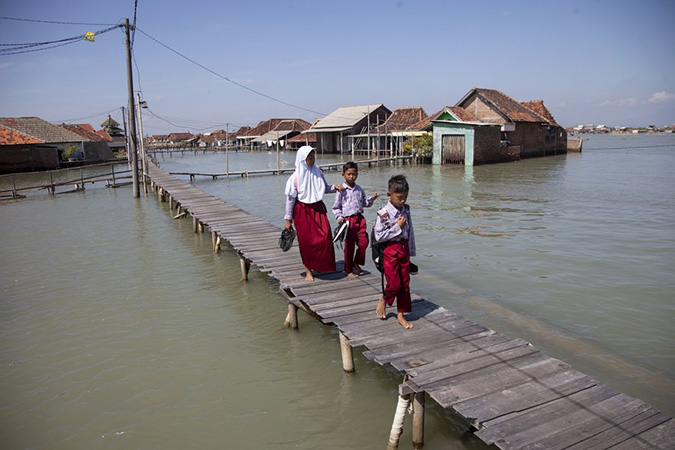
Her situation is a model, in miniature, of the broader plight of the Javanese village of Timbulsloko, located on the north coast of Central Java in Demak Regency, with a population of roughly 3,700. Many of the villagers have had to raise their floors multiple times, just as she has had to, and they face the ever-present threat of having to do so again as the water keeps returning. And the water is causing harm well beyond the scale of individual homes: Roads and rice fields have disappeared, gardens and trees have died, and the village cemetery has been inundated.
The film renders all of these settings and their predicaments with an unflinching visual intimacy. We see aerial views of a village that seems to float upon a vast inland sea, its scattered buildings reduced to distant pinpoints amid the surrounding water. We see people navigating narrow wooden walkways barely six feet wide and looking, from above, like strands of a spiderweb against a vast expanse of water. We see fishermen laboring in the water, mangrove planters sinking into mud and waves lapping at graves. We see boats carrying bamboo and lumber through the flooded landscape, materials that the boatmen then use to rebuild rotted boards on walkways in what increasingly resembles an exercise in futility.
Muslim is among the men overseeing the repair of rotted boards on one of the village's walkways. "These new boards won't even last five months in this salt water," he says. "We'll have to replace them again." But the workers are the very picture of determination as they pry up the decayed planks, haul in replacements and fasten them into place. The lumber is packed into canoes that look barely large enough to carry the load. The work is arduous and improvised, yet communal; when funds run short, villagers contribute what they can.
The cemetery is another front in the villagers' struggle against the water. Bamboo stalks form a makeshift barrier around graves that storms repeatedly tear apart, and the film follows residents as they return to rebuild it before Eid al-Fitr, the festival marking the end of Ramadan. They arrive by boat with bundles of bamboo, hammer the stalks into place and bind them to the existing structure while waves buffet the cemetery. For one woman, the effort has a deeply personal urgency: Her nineteen-year-old son is buried there, and seeing his grave submerged in water makes her feel as though he is "dying a second time. My son is in the water, but I won't let him disappear under it. One day he'll rest in a stone grave. I promised him that."
We also see a day in the life of former farmers who have turned to fishing now that salt water has ruined their fields. They do their best to adapt to each new loss, but we see their despair as they watch waves tear apart their fishponds and nets. We watch them wade through water, pulling their boats along and hauling the damaged nets into them. The catches are small, their equipment is deteriorating and a fish buyer determines what their catch is worth. One fisherman says that after half a day at sea he has caught less than two kilograms of fish, a meager return for hours of work in waters that have become their only remaining source of income.
There's also the story of a mangrove restoration project. We follow two villagers as they join environmental scientist Denny Nugroho Sugianto in planting the young trees along the coast, wading through mud to press each seedling into the sediment and secure it with a stick. The work can be almost comically difficult—the group laughs as one planter becomes stuck in the mud and the others have to pull him free—but it's at least something that can be done to slow the water's advance. More than 20 hectares have been planted, yet Sugianto makes clear that the project's work has limited returns. "In the end, though, our efforts can only slow the process of land erosion," he says. "According to our simulations, in 100 years, a vast area here will be completely underwater."
We hear varying perspectives on whether to stay in Timbulsloko or leave. About a third of the village's residents have left, while those who remain include those who can't afford to leave, those who hope the government will help the entire community relocate and others who are determined to stay. "One day we'll have to leave," one woman says; another adds, "When we go, we'll go together," since she can't imagine starting over without her neighbors and loved ones. Still another resident resolutely says, "I'll never leave this village."
Though the film does refer on a couple of occasions to climate change and its attendant sea-level rise, it does not reduce Timbulsloko's situation, or that of other vulnerable coastal communities, to a simple one-cause phenomenon. It also points to the disappearance of groundwater and the resulting subsidence of the land, coastal erosion and the disruption of natural sediment flows by industrial development. The loss of mangroves, once a natural defense against waves and erosion, has further weakened coastlines in many parts of Southeast Asia and elsewhere. What emerges, then, is not a crisis with a single culprit but a convergence of environmental pressures compounding one another.
It is a multifaceted predicament, and Timbulsloko is on its front lines. Yet its inhabitants joke, laugh, work together and find reasons to celebrate. Their resilience is perhaps best illustrated by the film's closing scene, in which villagers gather for a communal celebration, eating together and setting off fireworks and sparklers. We close on the sight of the villagers gazing in wonder at fireworks blossoming in the night air, as one of them defiantly tells us:
"I don't listen to the government or the scientists who say Timbulsloko will sink into the ocean one day and that we'll all have to leave. Only God knows our fate. The water has made us stronger. Our fighting spirit is still alive, and so is our joy in life."
Could there be a more stirring quote for such a sobering film to end on?